Jamu is an Indonesian herbal drink made from fresh roots, spices and fruit, with turmeric and ginger as its base. It has been made in Indonesia since the 8th century: the oldest evidence is carved into the reliefs of Borobudur on Java. In December 2023 UNESCO added jamu wellness culture to the Representative List of the Intangible Cultural Heritage of Humanity. In the Netherlands many people still know it by the older spelling djamoe.
On this page you will read what jamu is, where the word and its different spellings come from, who traditionally makes it, how to drink it and how Good Jamu brings it to the Netherlands.
What exactly is jamu?
Jamu is not a recipe but a tradition: a family of drinks passed down from generation to generation on Java and the other Indonesian islands. The base is almost always freshly pressed turmeric or ginger, complemented with tamarind, lemongrass, clove, cinnamon, pepper or palm sugar. Every island, every town and often every family has its own version.
In Indonesian tradition it has been believed for centuries that different jamu recipes belong to different moments and ailments: a jamu for after childbirth, a jamu for hot days, a jamu for the morning. That belief is part of the culture and of daily life, not of a label. We tell that story as it is: as tradition.
Jamu, djamoe or djamu?
If you searched for djamoe, you probably grew up with the sound the way your parents or grandparents brought it from the Dutch East Indies. All three spellings are the same word; the difference lies in the history of written Indonesian.
- Djamoe: the spelling of the Van Ophuijsen system of 1901, in which the j sound was written as "dj" and the oo sound as "oe". This is the spelling known to Indo-Dutch families and the older generation.
- Djamu: after the spelling reform of 1947, "oe" officially became "u".
- Jamu: since the reform of 1972, "dj" is written as "j". This is the current Indonesian spelling and the one Good Jamu uses.
The word itself comes from Javanese. According to the common explanation it combines jampi, an old term for a healing formula or incantation, and usada, health. Whoever writes djamoe is not spelling it wrong, just older.
The history of jamu
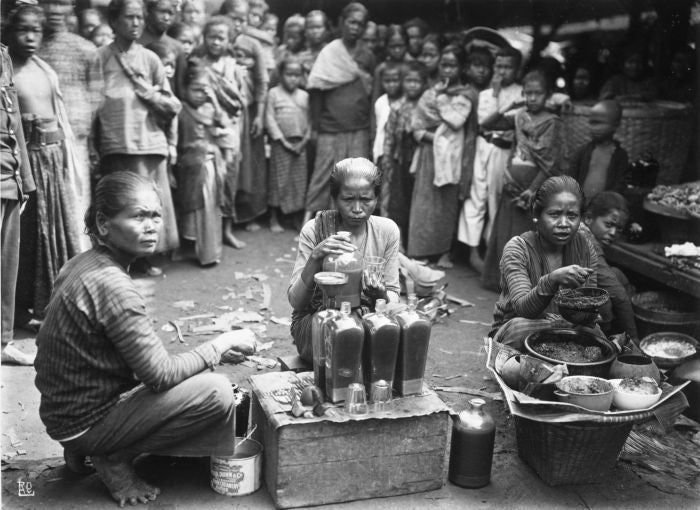
The earliest depictions of herbal drinks being prepared are found on Borobudur, built in the 8th and 9th centuries. In the centuries that followed, jamu was refined at the Javanese courts, where recipes were written down and preserved. From there the knowledge spread to the villages, where women prepared and sold the recipes every day.
Through the Dutch East Indies, jamu also reached the Netherlands. Indo-Dutch and Moluccan families brought the habit with them, often under the name djamoe, and passed it on to their children. In the Netherlands, jamu is therefore not a new trend but a habit with a Dutch history of its own.
Jamu gendong: the women behind the recipes
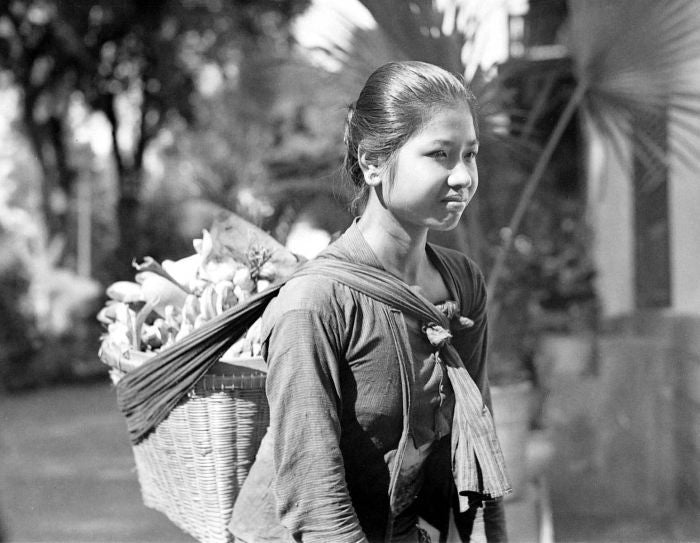
The bearers of the tradition are the jamu gendong: women who gather, grind and cook the herbs and carry the fresh jamu in bottles in a woven basket on their back (gendong) through the neighbourhood. They know the recipes by heart, know which root is at its best when, and adjust the drink to whoever is standing in front of them. Without them, jamu would have remained a manuscript in a museum.
Read more about the jamu gendong and their craft.
Jamu as UNESCO heritage
Since 2023, jamu culture has been on the UNESCO list of intangible cultural heritage of humanity (file 01972). An inscription like this offers no legal protection and says nothing about effects; it recognises that the knowledge, rituals and craft around jamu are worth preserving and passing on. That is exactly where it is under pressure in Indonesia: making jamu is labour intensive, and fewer and fewer people take the time for it.
How do you drink jamu?
Traditionally jamu is drunk in the morning, fresh and in a small glass. That is how it works with us too. One shot of about 33 ml a day, at a fixed moment, is the ritual.
- Neat, as a shot: spicy, fresh and direct.
- Warm: a dash in hot water, as a herbal tea.
- Cold: one part jamu to five parts sparkling water, with ice.
- In the kitchen: in a smoothie, a dressing or an alcohol-free cocktail.
Contrary to what is often thought, jamu does not have to taste bitter. Most jamu made today is spicy and slightly sweet, with tropical undertones. You will find ideas in our recipes with jamu.
Why do people drink jamu?
In Indonesia the answer is simple: because it is part of life. Traditionally it has been believed that jamu contributes to resilience, balance and overall wellbeing, and that belief has been the reason people drink it every day for generations. In the Netherlands we mainly see three reasons: people want a ritual instead of a quick fix, they want less coffee or alcohol, and they love the taste of fresh turmeric and ginger. We make no promises about what jamu does for you. We make it the way it should be made, and let the tradition speak for itself.
Jamu by Good Jamu
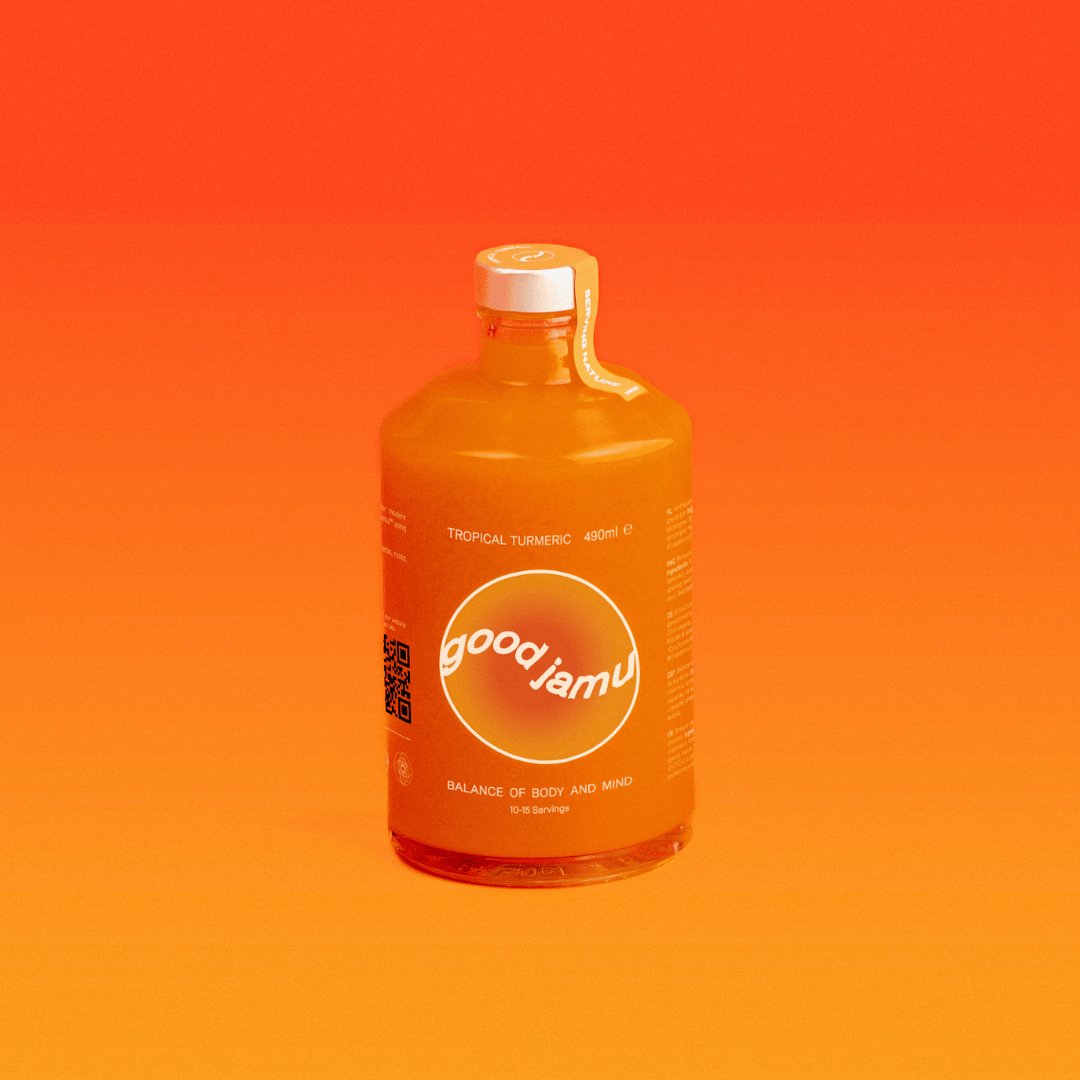
Good Jamu comes from Deventer and was founded by Anna Uspessij, who grew up in a Dutch-Moluccan family and learned the craft from the jamu gendong. Our jamu is made in the Netherlands from 100% organic ingredients, without powders, preservatives or artificial additives.
Not sure which one suits you? The Starterpack contains both concentrates and six cans. For hospitality and retail there is a B2B tasting pack.
Frequently asked questions about jamu
Does jamu contain alcohol?
No. Jamu is a plant-based, alcohol-free drink. That is why it is increasingly used as a base for alcohol-free cocktails.
Is jamu the same as a turmeric shot or ginger shot?
Not quite. A shot is usually one ingredient with juice. Jamu is a layered recipe of several roots, spices and fruits, made according to a tradition. A bottle of Good Jamu is also concentrated: about fifteen shots per bottle.
Can I drink jamu every day?
One shot a day is the ritual; that is how it is drunk in Indonesia too. If you take medication or are pregnant, check with your doctor.
Where can I buy jamu?
Directly in our webshop, always with free shipping, and at Albert Heijn, STACH and EkoPlaza among others. You will find more answers in our frequently asked questions.

 MOST POPULAR


